Gold Savings Accounts in UAE Banks – Are They Worth It in 2026?
UAE banks offer gold savings accounts that let you accumulate gold in small amounts without physical storage. Are they worth it compared to physical gold or ETFs? This analysis breaks it all down.
What Is a Gold Savings Account?
A gold savings account (also called a gold account or gold deposit) is a product offered by UAE banks that allows customers to buy, hold, and sell gold denominated in grams through their banking app or branch — without taking physical delivery. The gold is held on behalf of the customer, either in allocated form (specific bars identified as yours) or in an unallocated pool (you have a claim on a certain weight of gold from the bank's general pool).
These products sit between fully physical gold ownership and gold ETFs — combining the accessibility of a bank account with direct gold price exposure.
UAE Banks Offering Gold Accounts in 2025
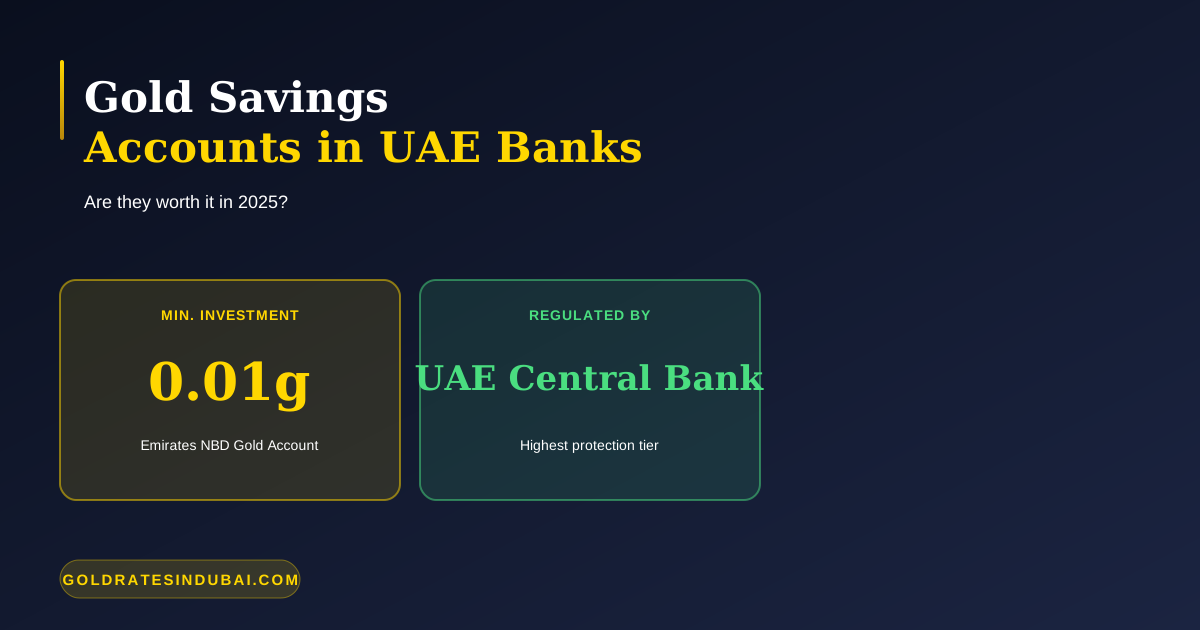
- Emirates NBD Gold Account: Purchase gold in 0.1g increments. Stored in allocated vaults. Accessible via ENBD app. Ability to take physical delivery of bars (minimum 50g).
- First Abu Dhabi Bank (FAB) Gold Savings: Minimum AED 100 per transaction. Competitive buy/sell spreads. UAE Central Bank regulated.
- Abu Dhabi Commercial Bank (ADCB) Gold Account: Available to personal and wealth management clients. Linked to global gold price with AED settlement.
- Dubai Islamic Bank (DIB) Gold Savings: Sharia-compliant structure. Gold is physically purchased and allocated — no interest element. Suitable for customers who need a halal gold savings product.
Costs of Gold Savings Accounts
| Cost Element | Typical Range |
|---|---|
| Buy/sell spread | 0.5–1.5% (varies by bank) |
| Annual storage/admin fee | 0% – 0.5% |
| Physical delivery fee | AED 50–200 per delivery |
| Account maintenance | Usually free |
Pros and Cons of UAE Bank Gold Accounts
Pros
- Regulated and trusted: UAE Central Bank oversight provides a level of consumer protection that unregulated platforms cannot match.
- No storage hassle: No need to arrange a safe or vault — the bank handles custody.
- Small minimum investments: Start with AED 50–100 rather than AED 300 for a physical gram.
- Integrated with your banking: Manage gold alongside your current account, savings, and investments in one app.
- Physical delivery option: Unlike ETFs, you can request actual bars if you accumulate enough.
Cons
- Spread costs add up: A 1% buy spread + 1% sell spread = 2% round-trip cost every time you trade. ETFs like SGLD charge 0.12% annually.
- No capital gains participation in some structures: Read the product terms carefully — some "gold accounts" are actually gold price-linked deposits that do not give you ownership of physical gold.
- Not portable: If you close your UAE bank account (e.g., upon leaving the country), liquidating or transferring your gold account can be complicated.
- No yield: Unlike a regular savings account, gold generates no interest or dividend.
Are Bank Gold Accounts Sharia-Compliant?
Conventional bank gold accounts (where gold is held in an unallocated pool with a contractual right to gold) may have Sharia compliance concerns because the customer does not own specific, identified gold — they have a debt claim on the bank. Fully allocated accounts (where your gold is in a segregated, identified vault) are generally considered compliant. Dubai Islamic Bank's and Abu Dhabi Islamic Bank's gold products use Sharia-compliant structures reviewed by their Sharia Supervisory Boards.
Gold Account vs Physical Gold vs ETF: Which Is Best for UAE Investors?
| Factor | Bank Gold Account | Physical Gold | Gold ETF |
|---|---|---|---|
| Regulated in UAE | Yes (Central Bank) | Yes (DET/DGJG) | Via broker |
| Physical ownership | Yes (allocated) | Yes | Indirect |
| Lowest minimum | 0.1g (~AED 30) | 1g (~AED 300) | ~USD 20 |
| Annual total cost | ~0.5–1.5% | ~0% (home) to 0.5% (vault) | 0.12–0.4% |
| Best for | Convenience savers | Long-term wealth/gifting | Active investors |
Verdict: Bank gold accounts are excellent for disciplined, small-amount monthly savers who prioritise convenience and regulation above optimising costs. For cost-sensitive investors or those accumulating larger amounts, direct physical gold or low-cost ETFs offer better economics over time.
Mr. Sajid Aslam
Senior Gold Market Analyst, GoldRatesInDubai.com
Sajid tracks the Dubai gold market daily — DGJG rates, souk premiums and the rules that affect expat buyers — and has covered UAE precious metals for GoldRatesInDubai.com since the site's early days. Read more about our team and data sources.
Share this article: