Dubai vs Singapore Gold Price – Where to Buy Smarter
Dubai and Singapore are both premier global gold trading hubs. This comparison helps investors and travellers decide which city offers better value for gold bars, coins, and jewellery.
Two World-Class Gold Hubs
Dubai and Singapore compete for the title of Asia-Pacific's premier gold trading destination. Both cities offer low-tax environments, LBMA-accredited supply chains, sophisticated financial infrastructure, and high concentrations of gold dealers and refineries. Yet meaningful differences in tax treatment, product availability, and market transparency mean one city often offers better value depending on what you are buying.
Tax Comparison: Dubai vs Singapore
| Tax Factor | Dubai (UAE) | Singapore |
|---|---|---|
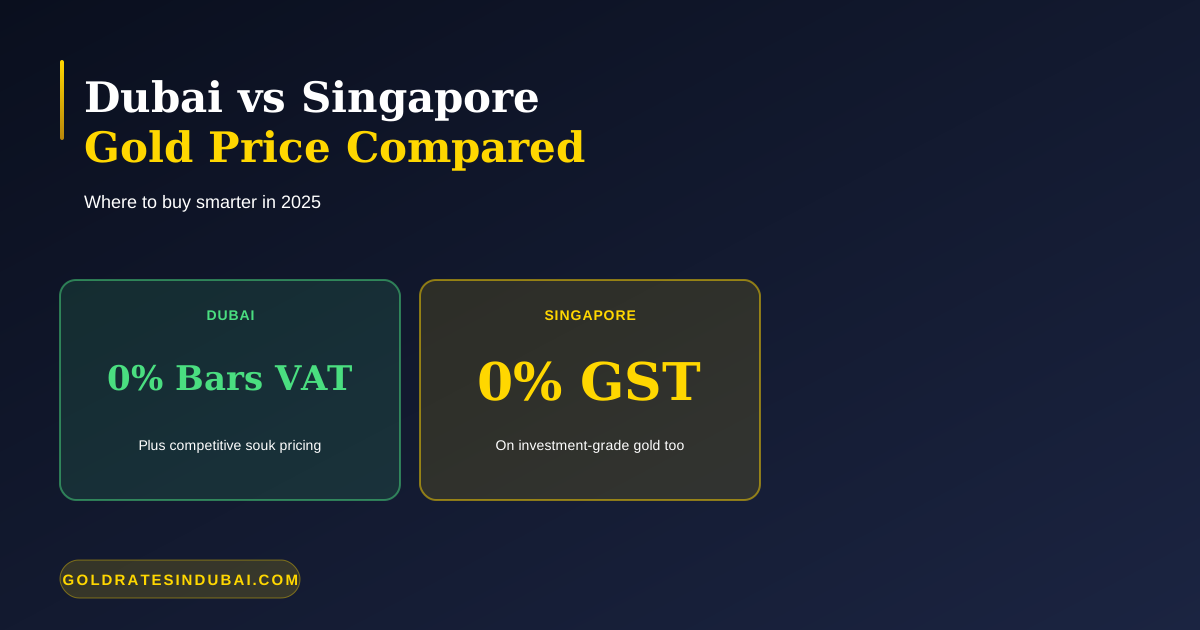
| VAT/GST on investment gold bars | 0% (exempt) | 0% (Investment Precious Metals scheme) |
| GST on gold jewellery | 5% UAE VAT | 9% Singapore GST (raised Jan 2024) |
| Capital gains tax | 0% | 0% |
| Wealth or estate tax | 0% | 0% |
| Tourist GST refund on jewellery | Yes (5% recovered) | Yes (9% recovered under Tourist Refund Scheme) |
Investment Gold Bars: Which City Is Cheaper?
For investment-grade gold bars (minimum 99.5% pure), both cities offer VAT/GST-exempt purchasing. The price difference comes down to dealer premiums:
- Dubai premiums: Typically 0.5–1.5% above the LBMA spot price for retail buyers of 100g–1kg bars.
- Singapore premiums: Typically 0.8–2% above spot, partly because Singapore imports all physical gold (no domestic refineries of Dubai's scale), adding freight and insurance costs.
On a 100-gram bar purchase at current prices (approximately USD 9,500 equivalent), Dubai's lower premium could save USD 30–50 compared to Singapore. Over multiple purchases, this difference compounds.
Gold Jewellery: Dubai Wins Clearly
Singapore's GST increase to 9% in January 2024 widened the gap with Dubai's 5% VAT significantly on jewellery. On a SGD 5,000 jewellery purchase:
- Singapore GST: SGD 450 (9%)
- Equivalent Dubai VAT (recoverable by tourist): AED equivalent of ~5% = AED 918 on a comparable piece, fully refundable at airport.
For tourists who can claim VAT/GST refunds in both cities, the net cost is similar — but for residents who cannot claim back, Dubai's 5% permanent advantage on jewellery is material for large purchases.
Selection and Market Character
Dubai's Gold Souk remains unmatched globally for traditional jewellery volume, design variety (particularly Arabic, Indian, and Pakistani designs), and face-to-face competitive pricing. It is a buyer's market with hundreds of shops competing for every customer.
Singapore's jewellery market (centred on Mustafa Centre in Little India and Chinatown jewellery shops) has a more organised retail feel with less aggressive price negotiation culture. Singapore excels at East Asian jewellery designs — 24K pure gold items popular with Chinese buyers — reflecting its demographics.
Gold Storage in Singapore vs Dubai
Singapore is globally recognised as the premier gold storage jurisdiction for high-net-worth Asian investors. The Singapore Freeport and Brink's Singapore offer world-class allocated storage in a jurisdiction with exceptional political stability, strong rule of law, and no gold confiscation history. For investors storing very large amounts (USD 1 million+), Singapore's storage credentials are slightly superior to Dubai's.
For practical amounts (under USD 500,000), Dubai's private vaults (Brink's Dubai, DMCC Tradeflow) are fully adequate and often more cost-effective for UAE-resident investors.
Verdict: When to Choose Dubai, When to Choose Singapore
| Situation | Better Choice |
|---|---|
| Buying traditional jewellery | Dubai (Gold Souk) |
| Buying East Asian 24K jewellery | Singapore |
| Investment gold bars (retail) | Dubai (lower premiums) |
| Large institutional gold storage | Singapore (Freeport) |
| Tourist shopping (net cost) | Roughly equal (both have tourist refund schemes) |
Mr. Sajid Aslam
Senior Gold Market Analyst, GoldRatesInDubai.com
Sajid tracks the Dubai gold market daily — DGJG rates, souk premiums and the rules that affect expat buyers — and has covered UAE precious metals for GoldRatesInDubai.com since the site's early days. Read more about our team and data sources.
Share this article: